E-Drive: Discharge Navigator
Background and Challenge
At Zuckerberg San Francisco General Hospital (ZSFG), the emergency department often feels like an island—cut off from outpatient care, social services, and community support. Many patients arrive with needs beyond immediate treatment, but with no clear way to access the services that already exist in the community. As a result, they return to the ER again and again, straining resources intended for true emergencies.
Led by Dr. Peabody of the Acute Care Innovation Center, our team partnered with clinicians across specialties to design the Discharge Navigator. The goal: reduce low-acuity ED visits and provide care teams with a consistent workflow to connect patients with social support at discharge.
Seeing the Whole Picture
We led the cross-disciplinary group in applying design thinking to better understand the people, systems, and programs shaping ZSFG. Through observations, stakeholder interviews, and participatory workshops, we mapped the safety-net ecosystem and surfaced key constraints experienced by patients, clinicians, nurses, and social workers.
Co-created personas and scenarios helped surface insights that shifted the tool’s focus: from patient-facing to provider-facing, from purely informational to decision-support, and from complex to simple. At its core was one actionable question guiding every interaction: “What do you need?”
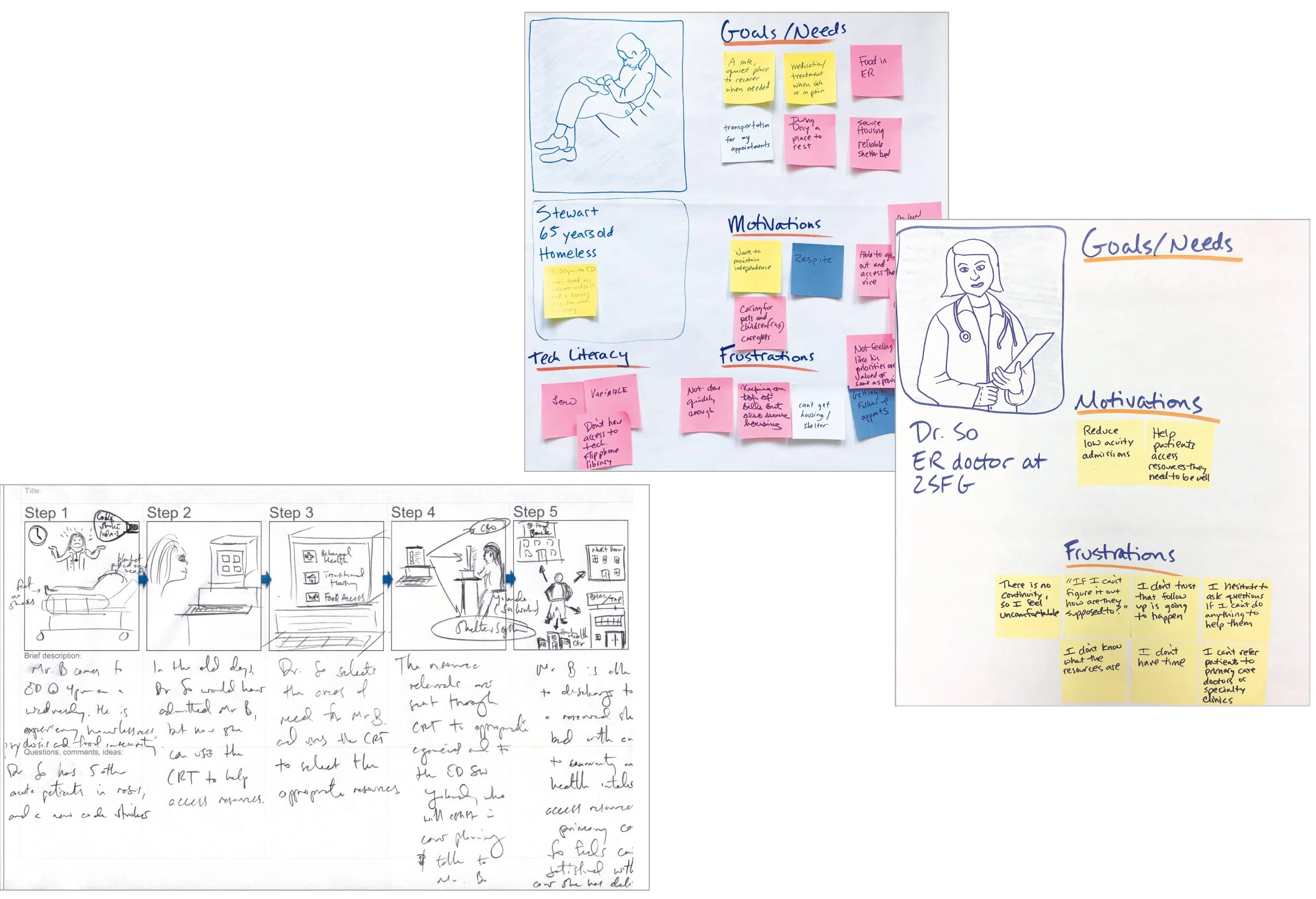
Scenario sketch and personas

Ecosystem mapping
Identifying People’s Needs
We started by uncovering the most pressing challenges clinicians face in connecting patients to community resources. Through observation, interviews, and social worker input, three recurring needs emerged—homelessness, substance use, and mental illness.
These insights directly informed the design of a digital prototype: a decision-tree tool guiding clinicians and residents to the right resources. It also generated clear, multilingual, and actionable patient handouts, ensuring patients left the ED with practical next steps.
Research Insights
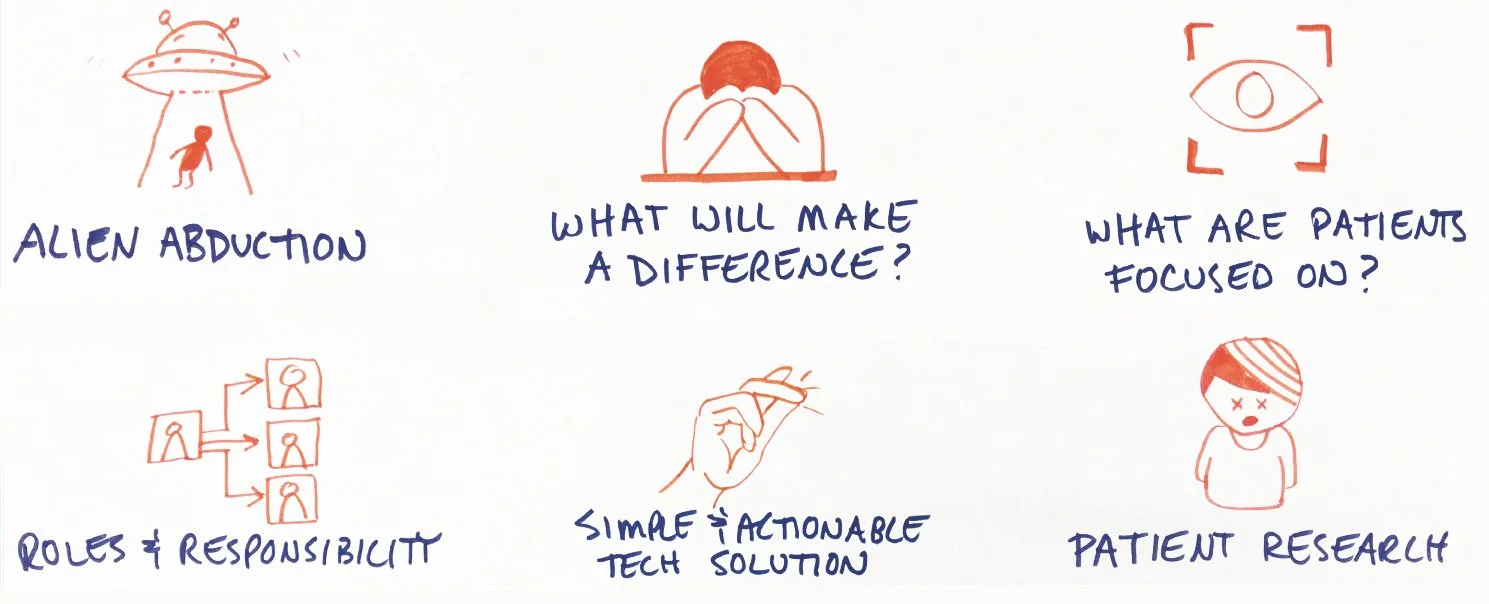
“They don’t always understand what happened. Why the are in the hospital. What they have or don’t have.”
“You can explain all you want, but they’re worried about their housing.”
“Whatever is created needs to be focused and simple. No scrolling and just one question per screen.”
Testing in Real Practice
Led by Dr. Stark, the prototype—built on open-source Drupal and managed by residents—was piloted in the ED for ten weeks. Residents used the tool in real patient encounters, refining workflows, evaluating usability, and ensuring it integrated smoothly into daily practice.
Surveys from the pilot confirmed the impact: clinicians reported increased knowledge and confidence in connecting patients to community resources, demonstrating how a simple, well-designed tool could make discharge more effective and reliable.

I designed discharge handouts tailored to each patient’s needs, available in multiple languages and covering key areas such as homelessness, substance use, mental health, food insecurity, and medical decision-making.

Low-fidelity wireframes
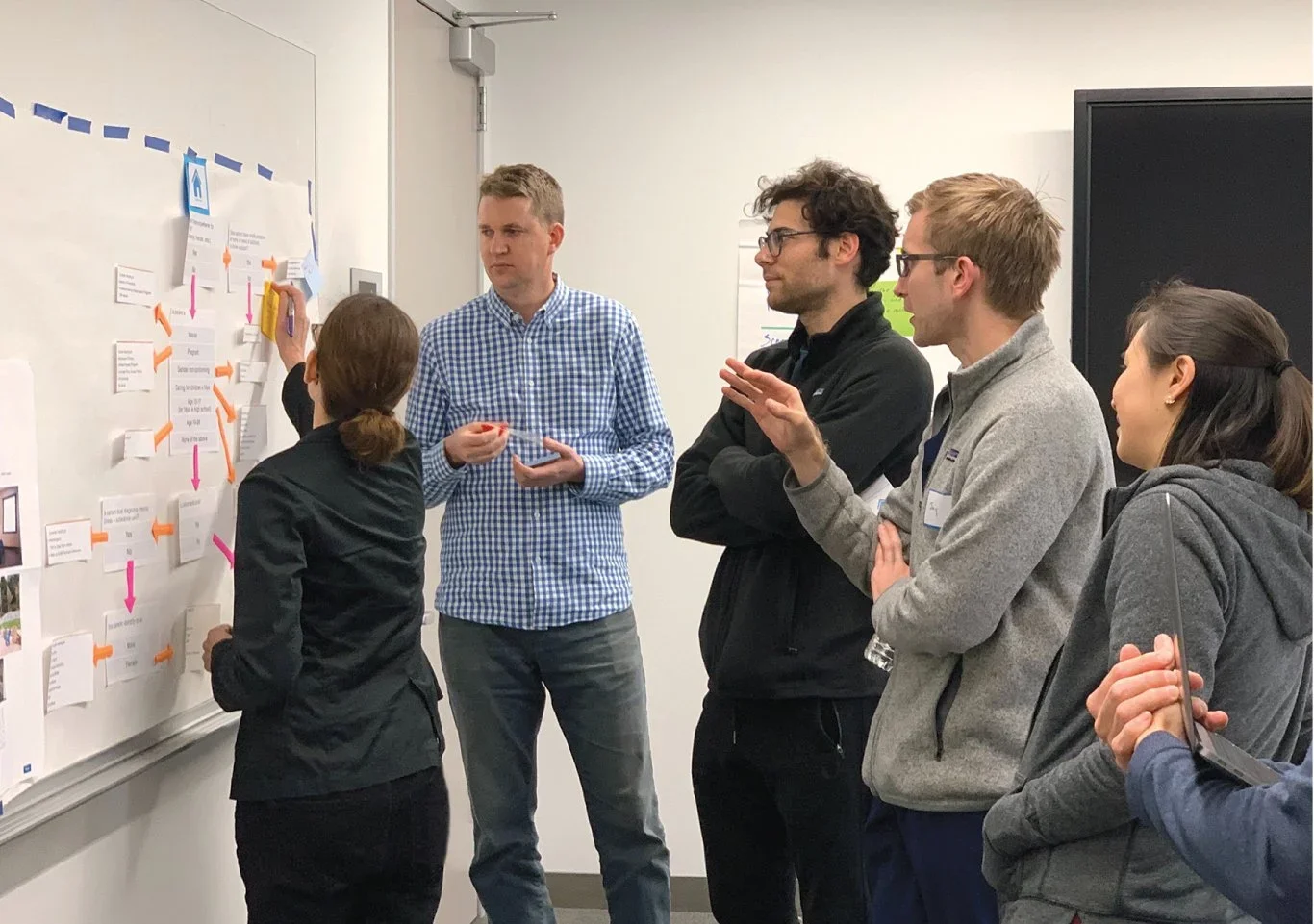
Decision tree co-creation with residents and clinicians
My Work
Led participatory co-creation sessions with stakeholders to create personas, scenarios, ecosystem maps, and success metrics, generating key opportunities and insights
Conducted eight ED observations and seven stakeholder interviews
Synthesized research findings into key themes
Co-designed decision tree with residents and clinicians
Gathered priorities from social workers
Built prototypes
Designed multilingual ED patient resource handouts
Created marketing collateral—poster and brochure
Coached UC Berkeley students on course-related project
Outcomes and Impact
The tool later evolved into E-Drive, a one-stop ED resource that combines discharge materials with quick guides for addressing a wide range of urgent issues encountered in emergency care. Evaluation by the Western Journal of Emergency Medicine demonstrated significant improvements in clinicians’ awareness and confidence regarding resources for homelessness and substance use.
Today, Discharge Navigator—rebuilt in collaboration with Shelter Tech—is in use by the Department of Public Health: https://dcnav.sfserviceguide.org/
Literature:
Finalist for an Emergency Medicine Innovator of the Year Award. A video on the site highlighting E-Drive’s success.
Dr. Stark’s presentation on E-Drive, Pg 95, Abstract #20 "Results: Up to 40% of on-site clinicians used the tool weekly. 53 clinicians completed the survey (rate of 46.1%). The tool significantly increased: self-rated knowledge of homelessness resources (32% pre to 74% post, p<0.0001) and substance use resources (17% to 65%, p<0.0001); confidence in accessing resources (22% to 74%, p<0.0001); knowledge of eligibility criteria (14% to 80%, p<0.0001); and ability to refer patients always or most of the time (12% to 45%, p<0.0001). 55% of respondents stated they used the tool one or more times per week, and 87% plan on using it more frequently. The mean likelihood to recommend the tool to other clinicians was 7.8 out of 10.”