CaptureDX
Background and Challenge
Pediatric trauma centers face unique obstacles to delivering expert-level care: low physician confidence with ultrasound and inefficient documentation often delay diagnosis and treatment. CT scans can fill the gap, but they carry long-term cancer risks for children. Dr. Kornblith wanted to change this. His lab at UCSF developed CaptureDX, an algorithm designed to work with point-of-care ultrasound (POCUS) to provide safer, faster, and more effective care—while advancing equitable access to expert-level pediatric trauma care.
To move from concept to practice, Dr. Kornblith partnered with our team to build an MVP and test whether an app-based POCUS workflow could integrate seamlessly into the clinical environment and run across diverse machines. Project goals: integrate real-time AI feedback; guide physicians to rescan and capture required anatomy; assist with study interpretation; and automate documentation.
Insuring Seamless Integration into the Workflow
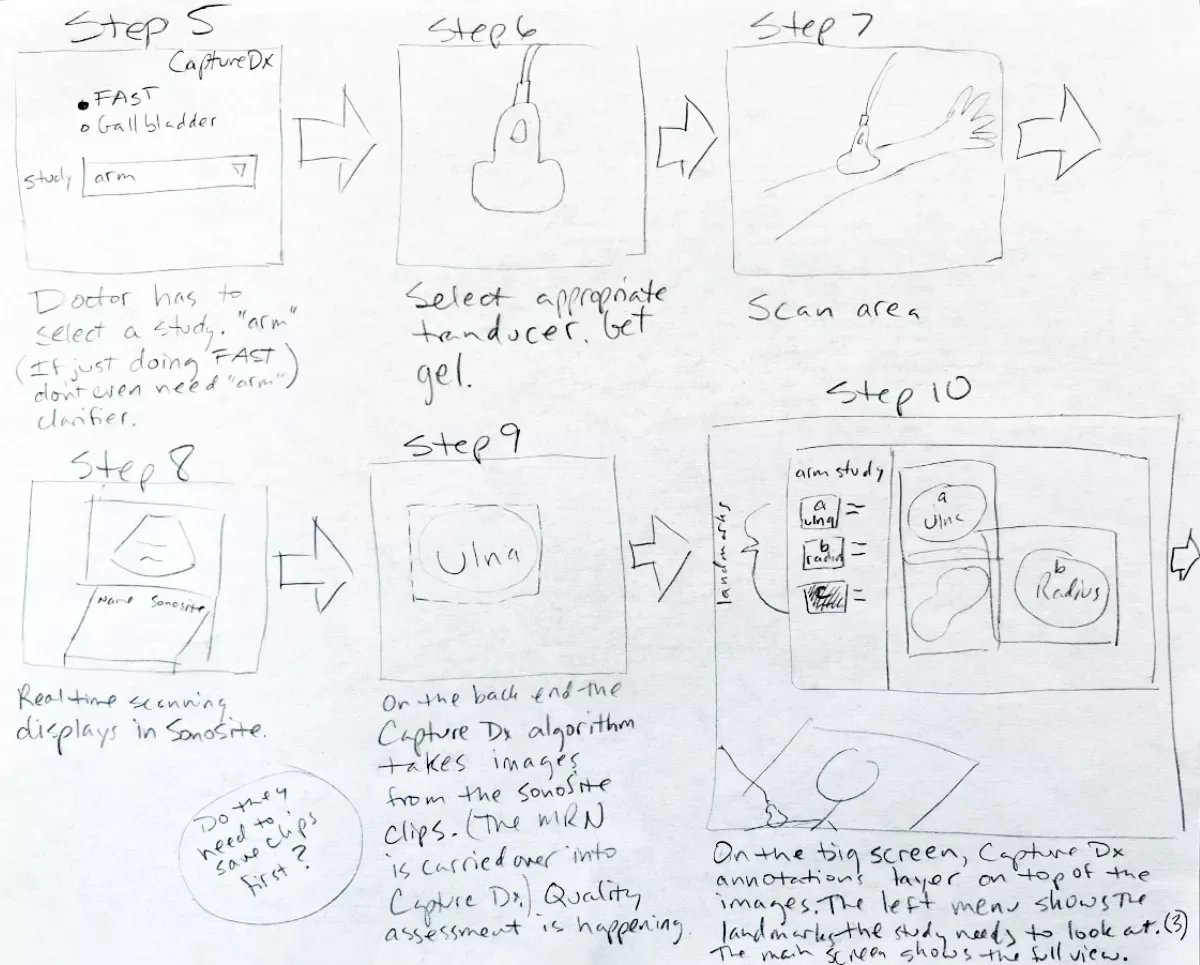
Our collaboration began with discovery. We mapped the Pediatric ER workflow to identify where the app could fit and how it would interface with ultrasound devices and the EHR, while in parallel creating sketches of user actions and system interactions.
Stakeholder-driven scenario sketches
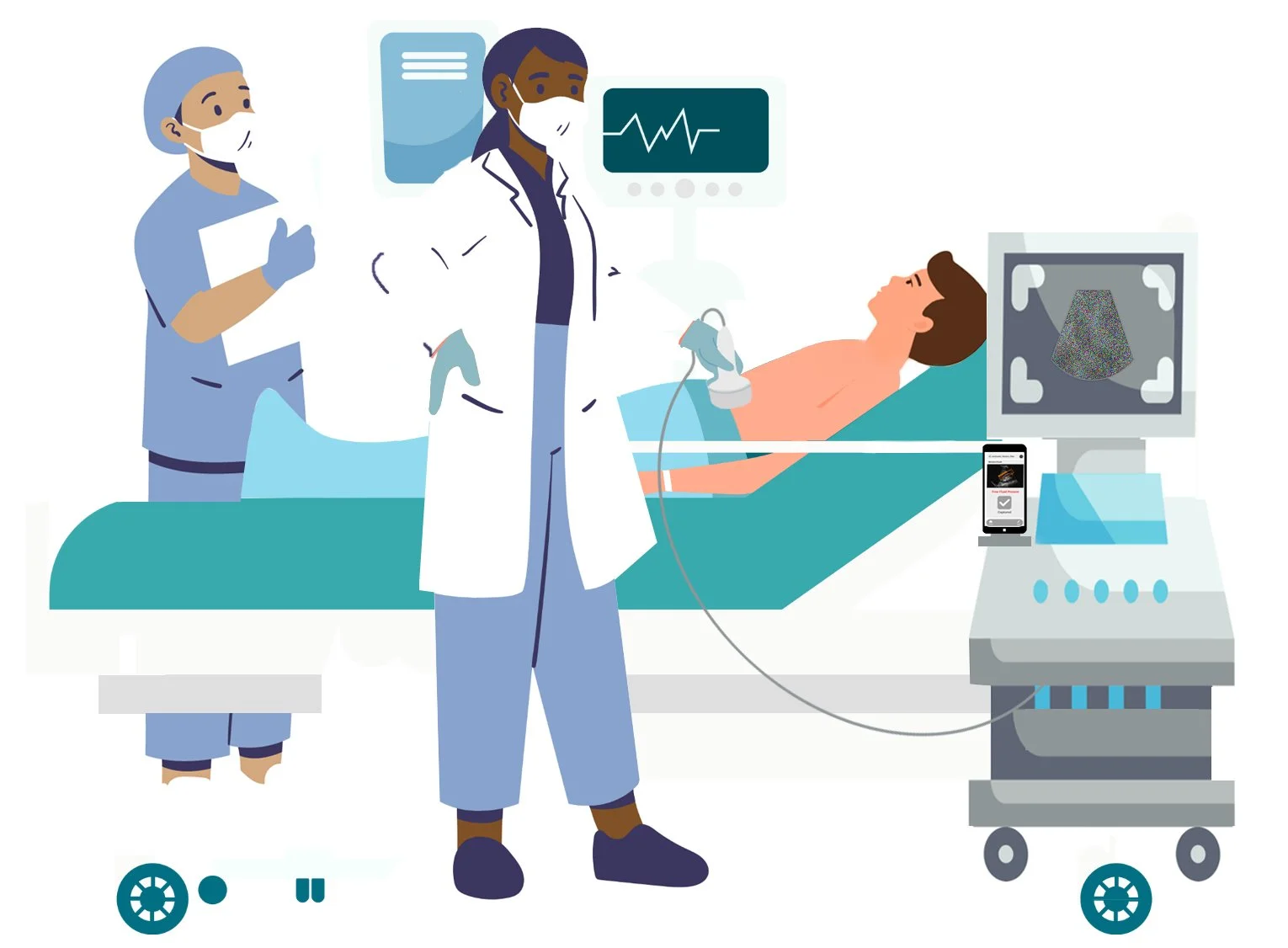
A story vignette showcasing POCUS in real-world use—compact, affordable ultrasound technology that helps clinicians make real-time, bedside decisions.

Observing clinical practice to identify where the tool fits within the workflow
Turning Insights into Innovation
With a shared understanding and clear product vision, I began wireframing the app, envisioning features to:
Capture: AI-assisted image capture that evaluates scan quality, identifies key landmarks, and prompts rescans when necessary
Interpret: AI-assisted diagnostic interpretation, that clinicians can review, accept, or modify
Document: Automated documentation to the EHR and billing system
Testing and Iteration
Wirerames became a clickable prototype, which we tested directly with physicians. Their feedback shaped refinements to the interface and confirmed what mattered most in high-pressure clinical scenarios. Quotes from qualitative interviews:
“Our work is interrupted all the time. And so the ability to come back and bookmark where you last left off, I think it’d be really helpful.”
“This could be a good teaching tool or device.”
“If this could be integrated, or like a subset of EPIC, I think that could be really successful.”
Insights
Insights from the physician interviews helped us improve the workflow, clarify next steps and tasks, streamline the interpretation and review process, add optional alerts, design effective cues, and finalize the integration plan.
Testing and Refining Designs Through Clickable Prototypes
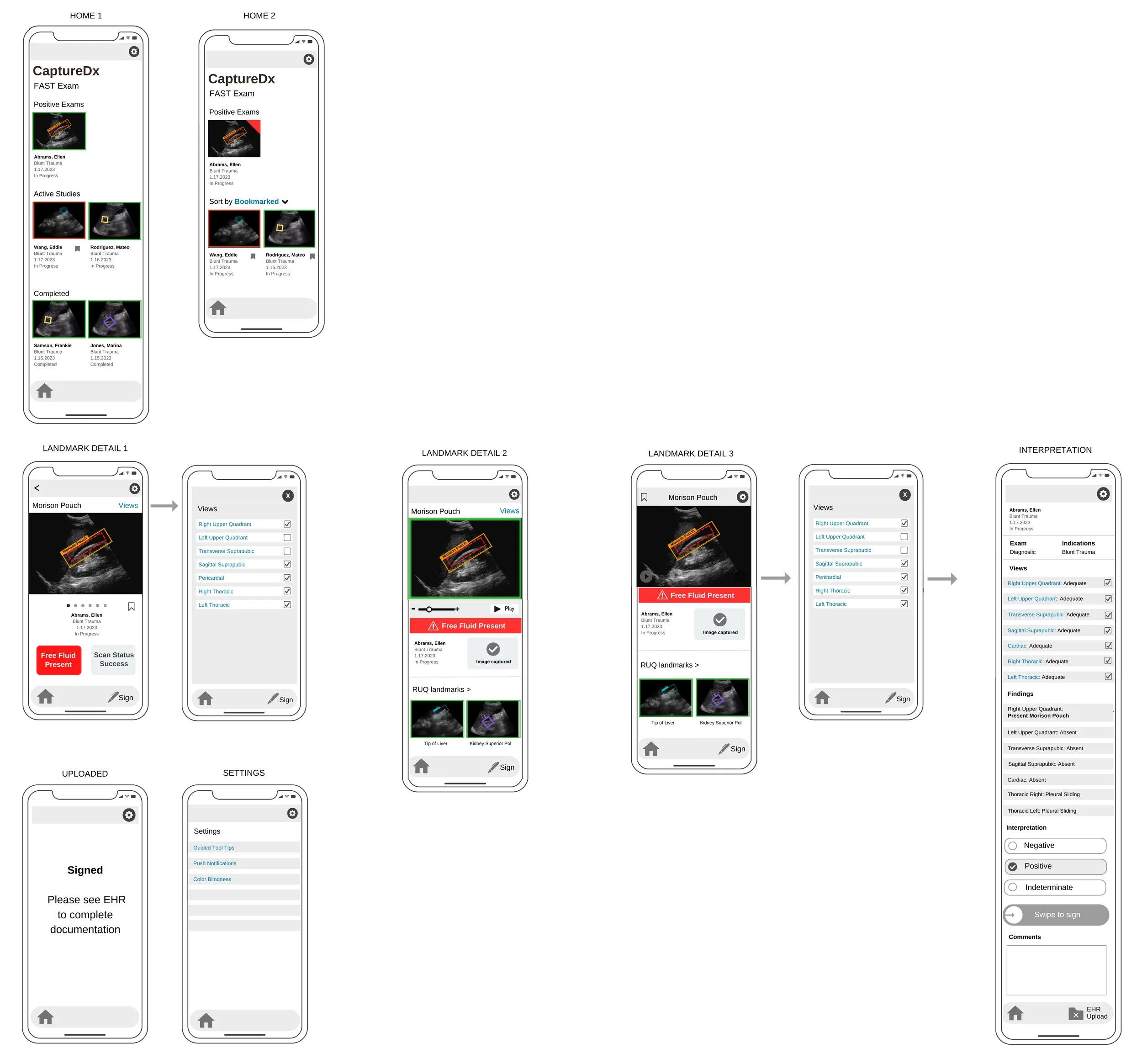
Wireframes for clickable prototype
My Work
Co-designed with stakeholders
Mapped scenarios and clinical workflows
Conducted analogous technology review
Wireframed and designed interactions
Built prototypes
Wrote user testing script
Conducted user testing
Synthesized research findings into key themes
Advised on presentation strategy
Outcomes and Impact
In 2023, CaptureDX was selected for the iHackHealth Appathon, where a UC Berkeley team developed the app with support from Apple engineers. Building on this momentum, the project received a 2024 Catalyst Award for mentorship and seed funding.
As POCUS becomes as common as the stethoscope, CaptureDX shows promise not only in trauma centers but across a wide range of care settings. The team continues to build on early insights to advance this vision.